
 As the below article states, the ships weren’t good enough for Jonah to hide from You. We can’t hide from You at any time or in any way. You see everything:
“Neither is there any creature that is not manifest in his sight; but all things are naked and opened unto the eyes of him with whom we have to do” (Heb 4:13).
Where ever we may go, You’re is there, You see everything:
“Whither shall I go from thy spirit? Or wither shall I flee from thy presence?
If I ascend up into heaven, thou art there: If I make my bed in hell, behold, thou art there.
If I take the wings of the morning and dwell in the uttermost parts of the sea;
Even there shall thy hand lead me, and thy right hand shall hold me.
If I say, surely the darkness shall cover me; even the night shall be light about me.
Yea, the darkness hideth not form thee; but the night shineth as the day: the darkness and the light are both alike to thee” (139:7-12).

“Am I a God at hand, saith LORD, and no a God afar off?
Can any hide himself in secret places that I shall not see him? Saith the LORD. Do not I fill heaven and earth? Saith the LORD” (Jer 23:23-24),
You see our evil deeds, but once we repent and stop doing them You forgive us.
Jonah had run to Tarshish in the hopes of running from You, so…
Jonah 3
Jonah Preaches at Nineveh
1 And the word of the LORD came unto Jonah the second time, saying,

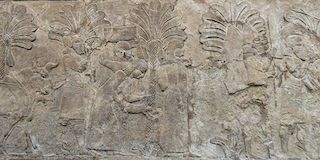
The king is shooting arrows while attendants repulse an attack from a wounded lion.
2 Arise, go unto Nineveh, that great city, and preach unto it the preaching that I bid thee.
3 So Jonah arose, and went unto Nineveh, according to the word of the LORD. Now Nineveh was an exceeding great city of three days’ journey.
“Exceeding great city” – which says the city had more than 120,000 inhabitants. Archaeological excavations indicate that the later imperial city of Nineveh was about eight miles around.
The fact, however, that the city was a “three days walk” may suggest a larger area, such as the four-city complex of Nineveh, Rehoboth, Calah and Resen mentioned in Gen 10:11-12.
Greater Nineveh covered an area of some 60 miles in circumference. On the other hand, “the days” represented, in the ancient Near Eastern idiom, a long journey.
Or it may refer to the length of his ministry there at Nineveh.
Another alternative is that God transported Jonah from the ocean to Nineveh.
4 And Jonah began to enter into the city a day’s journey, and he cried, and said, Yet forty days, and Nineveh shall be overthrown.
5 So the people of Nineveh believed God, and proclaimed a fast, and put on sackcloth, from the greatest of them even to the least of them.
6 For word came unto the king of Nineveh, and he arose from his throne, and he laid his robe from him, and covered him with sackcloth, and sat in ashes.
“King of Nineveh” – probably the king of Assyria, though this could refer to a governor or important city official.
7 And he caused it to be proclaimed and published through Nineveh by the decree of the king and his nobles, saying, Let neither man nor beast, herd nor flock, taste any thing: let them not feed, nor drink water:
8 But let man and beast be covered with sackcloth, and cry mightily unto God: yea, let them turn everyone from his evil way, and from the violence that is in their hands.
9 Who can tell if God will turn and repent, and turn away from his fierce anger that we perish not?
10 And God saw their works that they turned from their evil way; and God repented of the evil, that he had said that he would do unto them; and he did it not.
Seafaring in the Ancient World
Seafaring in the ancient Near East extends back well into the third millennium B.C., a period during which Egyptian sources refer to the “Byblos ship” (a term that signified any large, seafaring vessel).
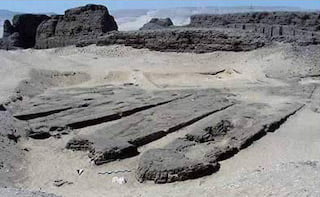
These 75 foot long ships are buried side by side and have wooden hulls, rough stone boulders which were used as anchors, and “sewn” wooden planks. Also found within their desert graves were remains of the woven straps that joined the planks, as well as reed bundles that were used to seal seams between planks. The Abydos ships have the honor of being the worlds oldest planked boats.
Such ships carried the valuable cedars of Lebanon and other prized timber from the northern Levant (Syria-Palestine) to Egypt. During the second millennium B.C. Ugaritic letters also report seafaring trade along coastal Canaan.
A shipwrecked vessel from around 1300 B.C. near Uluburun, Turkey, managed to preserve its cargo of olives, pomegranates, figs, various spices and nuts.
Twelfth century B.C. pictures from Mendinet Habu carved into the temple of the Egyptian pharaoh Ramses III depict the naval battle between the Egyptians and the Sea Peoples, a mysterious new emigrant group who brought with them naval technology that revolutionized seafaring in the Near East.
The Phoenicians were especially great naval innovators, building a maritime trading empire that extended west to Carthage and beyond. Two 8th century Phoenician shipwrecked crafts laden with wine amphorae have been located in the Mediterranean, approximately 31 miles from Ashkelon.
The Bible also speaks of Phoenician maritime skill in 1 Kings 9:26- 28, where Solomon is said to have established a fleet at Ezion Geber, on the shore of the Red Sea, staffed by Phoenician sailors to make the run to Ophir for the gold trade. It is clear that seafaring already boasted a long history by the time of Jonah.
Joppa, on the Mediterranean coast, was one of the major seaports in the region during Jonah’s day. Ships of Tarshish were heavy, seagoing vessels perhaps named for a geographical location or for their metallurgical cargo.

Scholars once speculated that ships of this time hugged the coast and did not venture into deeper waters, but this is no longer believed to have been the case; the ship Jonah took was probably capable of going far out to sea.
The most likely geographical candidates for Tarshish are Tartessus in southwestern Spain or Tarsus in southeastern Asia Minor.
Despite this ambiguity, it is clear that Jonah knew he could flee west from Joppa aboard a ship. Yet he would soon discover that not even these mighty vessels and their advanced Phoenician technology could separate the Lord’s prophet from the God of Israel.
…let’s take a look there.